

Madrid

(I confess that I can't really keep up with this thing, effectively. I hope you'll forgive me.)
When my parents were planning their grand Spanish adventure, I had recommended a couple places for them to go visit that I had already been to (Granada, Córdoba, Ronda) and others that I had not been to yet (Cádiz, Madrid). On that note, Meagan and I got to spend (almost) an entire weekend with them in Spain's capital city!
Background on Madrid: it is the 3rd largest city in the European Union (based on the size to population ratio). It is the epicenter of all Spanish economic and political history since the Renaissance and re-conquest of Spain, to good and bad degrees. It is a very financially-based city, as in most of the way it gets its wealth is from deals with other autonomous communities of Spain, member states of the EU, and banks. Lots and lots of banks. It is also where "Castillian Spanish" is most stressed as the "correct" way of speaking, much like Catalan is in Barcelona. For this reason, it can be perceived that some madrileños have cultural chips on their shoulders. However, this is not really true. Overall, Madrid is a very nice city: very pretty, friendly, open, and ornate.
The one qualm I have with Madrid is that it's kind of lackluster in terms of an atmosphere. Sure, people go out in La Puerta del Sol or Parque del Buen Retiro or Plaza Mayor to sit and chat; there's certainly a buzz. But the buzz is much more relaxed than the buzz of Barcleona or Paris. It's a very high-society buzz. Maybe that was because of our centralized location, but even with people strolling the streets at night looking for bars, night-life hot-spots, or outdoor gatherings, the buzz was...controlled, if you will. It's hard to explain.
This is not saying that I didn't enjoy Madrid. I did! We did lots of cool things. Right off the bat, we headed over to the Royal Palace and got to take a tour inside there. The palace is huge! You might say, of course it is, but I might say, you say that now but wait till you see a palace. Granted, we had seen palaces before (Reales Alcázares in Sevilla, La Alhambra in Granada), but none that were the least bit modern (and by modern, I mean built shortly before, during, or shortly after the Enlightenment). Not only was the outside extravagant, but it also looked over this magnificent view of a valley right next to the palace. (Pictures below.) And of course, the inside of the palace made all four of us want to live there. Peculiar/awesome things:
- The throne room was full of chandeliers and brightly-colored rugs and fabrics, but what was weird about it was that it was a giant rectangle, and instead of the thrones being at one short end of the rectangle as you would expect, they were situated against the long wall, right in the middle. It was odd and kind of off-putting at first.
- The dining room was humongous, with a table for 70 or so people. Crazy.
- Inside the palace was a series of Stradivarius string instruments (!!!), decorated with inlay in the perfling (outer rim) of each one. I couldn't stay in there too long for fear I might have done something I would've regretted later.


Later that same day, we ventured over to the Museo del Prado for their free hours (6-8 p.m. on Fridays). The Prado is arguably the most important art museum in Spain; it is host to all sorts of art, Spanish and non-Spanish, I guess from the 1700s-1900s (?). I don't know my artistic time periods, so I don't really know how to characterize it. I know that there was hardly any "Impressionistic" artwork there. So I'll give you some names and maybe you'll get the idea. The Spaniards that were represented included: Goya, Velazquez, and El Greco. The only non-Spaniard I remember seeing was Hieronymous Bosch, because Meagan really wanted to see his triptych, The Garden of Earthly Delights. It's a crazy painting with so much going on, and represents a side of religious-based art I had yet to see even after visiting the Museo de Bellas Artes in Sevilla. It was a little more brash and brazen, and I appreciated that.
A painting I appreciated even more for different reasons was Las meninas, by Velazquez. That may ring a bell: in my post about Barcelona, I mentioned that we saw Picasso's surrealist/cubist version of Las meninas. At the time, I thought this was cool. But then I saw the original:
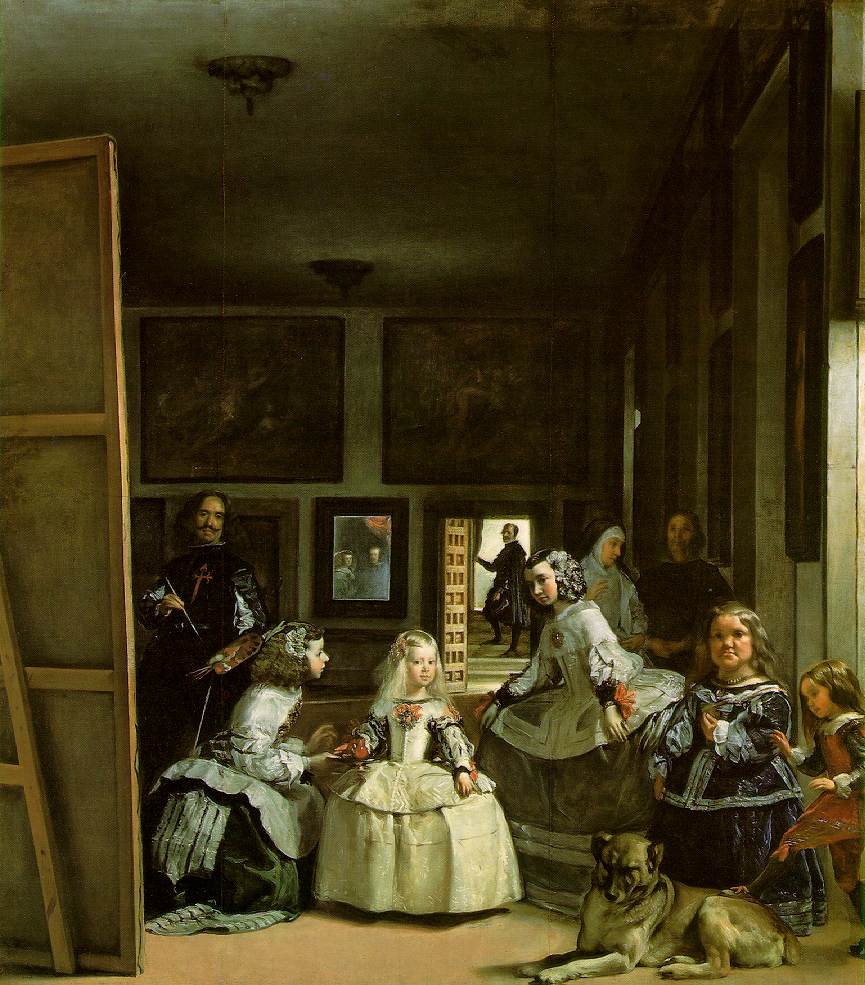
Everything in this painting is spectacular. First of all, it just looks pretty. The girls in dresses, their ladies in waiting, etc. Secondly, it's composed really well, with all of our attention diverting on the little girl first. It's not even off-balance because the Duchess is in the center, despite the easel infiltrating the frame considerably when something else could go there in its place. Then you start to notice every little Easter egg that Velazquez hides in it:
- Everybody is looking at you. The Duchess, one of her ladies in waiting, the old woman, the painter (Velazquez himself), even the chamberlain exiting in the back. Why are they looking at you?
- Because their watching you get painted. And by you, I mean the king and queen. Look in the mirror over Velazquez's left shoulder: that's their reflection.
- So then you start to feel awkward because everyone is watching you get painted except it's not you being painted but instead someone with much higher status than you. Then you suddenly feel out of place because not only are they looking at you, but they're glances change from passive to active, wishing you out of the picture so that Velazquez can finish.
- It's a picture within a picture within a picture. You realize this after you realize that the king and queen are being painted, and that the canvas on the easel will later become the one that is hanging proudly in the Prado that you are now looking at. MIND TRIP.
Anyway, this is my new favorite painting. Even Picasso's Guernica, which I stared at for just as much time in the Reina Sofía (also in Madrid), which moved me, did not make as much of an impression. It certainly did make an impression, just a different one. What I'm trying to say is, Las meninas is my new favorite.
After the Prado, we ended up going to the Hard Rock Cafe to eat. I know this may seem like a dumb thing to do, but after not having American food for 3 months (Spaniard's attempts at making hamburgers do not count), it was nice to sink my teeth into something I've been missing. And that was a burger. My parents really wanted to go too, and I did not have the willpower or the want to insist otherwise.
 Saturday saw us go to Toledo (look for that blog post later/tomorrow(?)), and then come back to go to the other really important art museum in Madrid, the aforementioned Reina Sofía, which was actually built to house Guernica, Picasso's incredibly political, anti-Franco mural-esque painting about the small village of Guernica in northern Spain. Here's the story behind it:
During the Spanish Civil War, Franco was laying destruction to the majority of Spain as he went around conquering it. At the time (I'm not sure about the situation today), Guernica was the capital of the Biscay province in Basque Country. In order to help Franco win the war, some of the Nazi German air force and the Italian air force bombed Guernica, killing several civilians and effectively handing over power of the Basque Country to Franco. (This is darkly ironic because Franco later did not participate in World War II -- he did provide the Axis Powers with under-the-table troops, but he wanted to keep his hands clean. In short, he was an a**hole.) Hearing about this, Picasso, who was living in France, was commissioned to paint a mural for the Paris International Exposition for the Worlds Fair in 1937. After he finished it and it was displayed at this expo, it went touring, and eventually found a home in the MoMA in NYC, where it remained until 1981. Franco had evidently expressed interest in having the painting transported back to Spain (which is also ironic, since he was largely the cause of its creation), but Picasso wouldn't allow it until Spain became a republic once more. After Franco died and this came true, it was housed in an annex of the Prado, where it was placed behind bulletproof glass and guarded by machine guns. Now, since the Reina Sofía has been built, it has a much less hostile home, although the museum employees will get angry with you if you take direct pictures. (They disallow them out of respect for the art.) If you want more information, check out the Wikipedia page here.
My personal experience with Guernica was very powerful. It is a huge painting -- literally, huge -- and its size contributes to its grandeur. The faces on the painting are the most harrowing things in the work, really displaying how pained the citizens must have/could have been. I wish I could describe more for you, but it's difficult. Just take the time to examine it closely, even if you don't like Picasso. It really is a fantastic piece of art.
After we left the Reina Sofía, we were lucky enough to have an opportunity to see a high-end flamenco espectáculo for nearly nothing, just a price of a bottle of wine. This was thanks to Marisol, whose friend is the principal dancer in the company. We enjoyed a nice bottle of wine, some free tapas, and a phenomenal show, containing two parts: a nice fusion of flamenco dancing with modern music, and then later more traditional music and dancing. It was extraordinary! Luis, Marisol's friend who got us our nearly-free table, was so nimble in the way he moved and yet so assured of where he was going that it partially convinced me that maybe flamenco wouldn't be hard (because he made it look so easy). Of course, that's ridiculous. We got to meet him afterwards, and he was so nice and was so glad that we were able to make it. He made sure to tell me to give Marisol his greetings and lots of besitos (little kisses) for him.
The next morning, Mom and Dad had to go. It was really hard seeing them go because I enjoyed my time with them so much. They got to go off and do their own thing quite often, but we got to see each other a lot too. I was so happy to share a bit of my experience in Spain with them (the food, the sights, the lifestyle, the main attractions, etc.) and talk with them about how things are going here and how things are going back home. And even though I miss home more than ever now, it really made me feel grateful for this opportunity, even more so than I already did. Because it is once in a lifetime. And to have parents that understand that and wish me well and enjoy themselves when I show them how I've been living in my home away from home, that's a blessing. So I just want to thank them again! (And apologize that it's taken so long for me to write this post.) You guys are the greatest.
After they left, though, Meagan and I still had quite a bit of time before our train back to Sevilla. This mainly consisted of going to the market and getting some food, sitting in Plaza Mayor and eating most of it, and then walking down to Parque del Buen Retiro and sitting and enjoying more food. The park had several attractions in it, namely some kind of stone pavilion alongside of a rectangular pool, a "Crystal Palace" made out of glass that is actually a satellite site of the Reina Sofía, and several street performers and artists. One guy we saw made an exquisite finger painting (that didn't look like a finger painting at all, but more like a professional one) in 5 minutes flat. They were pretty cheap, but there was a line and I had no idea where I would put it in my bag. Here are some pictures of the park:


So that was Madrid! We really only did 4 or 5 things in it because that's all that we felt there was to do. But that's okay! We enjoyed ourselves and that was important. I definitely don't want to discourage anyone from going there, because you will enjoy yourself. I promise. My experience is not everyone's. Go! Spain is Spain. I love all parts of it.
Nick


Read Users' Comments (0)


