Arrival in London: The Completely Different Attitude of the English Towards the Rest of Europe

Passport control in airports is heinous all over the globe.  I'm sure it's especially heinous getting into the US, however necessary it is.  One great thing about the European Union is that it essentially renders all borders between nations as moot, at least in economic, social, and educational affairs.  Politically, the nations are still nations, as they should be.  However, tariffs don't really exist in the EU, which is something that strong borders would bring, nor are there any rules for traveling in and out of certain countries.


This is because a lot of their countries have subscribed to something called the Schengen agreement.  This agreement puts in writing the fact that if you are a citizen of one country (and, it goes without saying, of the EU as a whole) that has signed the agreement, you can travel to any of the other countries that have signed it without going through border control.

Well, guess which country hasn't signed the Schengen agreement?  The United Kingdom.

I don't mind waiting in lines, even 1 hour long lines, but I do mind waiting in lines at 11:00 at night, when I have an 11:30 bus to catch (that will take 1 hour as well), and when I have people waiting for me where the bus lets off.  So the 1-hr. wait at the UK passport control made me a little testy.

It also got me thinking about why the United Kingdom hasn't signed this important agreement.  It's not that they're the only ones: as I would find out later, in my class about the EU, countries like Denmark and the Czech Republic also haven't signed the agreement.  (Curiously, the UK and the Czech Republic also aren't on the Euro.)  Perhaps we could say that they just like to keep track of who comes in and who goes out.  But that's too simple.

I, personally, think the real reason is that the UK doesn't like being considered European.  While we were visiting, we met several Londoners who preferred to think of themselves as English rather than European.  I said that they weren't mutually exclusive.  But they insisted they were, arguing that they were close, but they were an island: separate, self-sufficient, and strong.  (And I can see that argument, but not from someone who has joined The European Union.  Maybe Iceland doesn't consider themselves as being part of Europe, which is fine, considering they're not calling themselves European.)

So then if you don't want to be identified as being part of Europe, the question then becomes why are you a part of the European Union?  Well, it can't hurt to be a part of it, that's for sure.  The European Union now has one of, if not the singularly strongest open, free market in the world.  No one can deny the sheer power of their economic system.  So even though the UK was hesitant to join at first and altogether prefer to keep their distance from Europe, joining presented an economic benefit for both them and the rest of the EU.

So they joined.  Then what?  Well, there are two modes of thought throughout the EU: in Spanish they're called, europeistas and federalistas ("Europists" and Federalists).  "Europists" seek to create a United States of Europe (Eurasia?  Because Turkey wants to join as well.), essentially, where there is free movement within states while still maintaining sovereignty for each member state.  The Federalists are radically opposed to this, seeking to move as far away as possible from a huge conglomeration of states to retain as much national sovereignty as possible.  Well, The UK is one of these such Federalists.  Here are examples: they're not on the euro (and certainly not suffering for it), they haven't signed the Schengen agreement, they're one of two countries not on the European Union standard time system, and they drive on the left-hand side of the road.  Nowhere else in (the) Europe(an Union) does that last one happen (although you may think it does).

I pondered this throughout the course of my trip there and couldn't really come up with an answer, except that either the UK is using their economic security and position of power to take advantage of the benefits of the European Union without giving much in return (and no, English as the universal, "official" language of the EU does not count as a return gift, though it would be extremely hypocritical if it was), or they're just in denial.  Or they recognize the issue but pretend it's not there.

And all of this still doesn't change that every time you go to the UK, you'll have to wait in a line for an hour before they check your passport.

  • Digg
  • Del.icio.us
  • StumbleUpon
  • Reddit
  • Twitter
  • RSS

Toledo


When my parents were here and we were all visiting Madrid, we decided it would be a good idea to get out of the city and go to another town called Toledo.  It's only a 30 minute train ride from Madrid to Toledo (and it goes especially quickly when traveling on the AVE, something like 250 km/h!), which makes it a day-trip hot-spot for city-dwellers and tourists alike.

Toledo seems like a smaller city at first glance, but it is the capital of its own province, and also the capital of the larger autonomous community of Castilla-La Mancha.  (By the way, La Mancha is where Don Quixote had his famous fight with the windmill-giants.)  So it's still pretty large.  The historical center of town is easy to explore in a day's worth.  Toledo sits on a hill, surrounded on nearly three sides by el Río Tajo (or the Tagus, in its anglicized version) and overlooks a beautiful countryside full of "mountain" homes and smaller villages.  It's really one of the most beautiful places I've been so far.  It's a regular, old city on a hill!

When we got there, we went into the center of town, taking one of the several possible bus routes.  Yet we still managed to get off at the wrong stop.  We went into a local tourist office and got the necessary items: a map, a list of attractions, etc.  And although there was a battle reenactment going on that day we were there, we had already pretty much decided where we were going to go and what we were going to see: La Catedral de Toledo and the El Greco museum.

Toledo is very hilly, yet somehow incredibly compact at the same time.  We snaked our way through buildings and alleys and such until finally we found where we were supposed to be going to La Catedral.  The town was pretty much empty while we were making our way through it, but once we got to the plaza outside the cathedral, suddenly we ran into everyone!  Evidently, there was some kind of exposition of old cars that was going on.  And if we weren't on such a tight schedule, we may have stopped to check it out a bit more.  But we were kind of in a hurry.  (We were also approached by a man several times who told us to go check out this artisan-works that he and his buddies had put together, and after nicely telling him we'd think about it, we ran into him three more times before we had to say goodbye.)

Onto the cathedral.  I don't know if I mentioned in my post about Sevilla's cathedral, but the cathedral of Toledo at one point in time kind of had a running competition to outdo Sevilla's.  Sevilla's is, of course, bigger in general (with seven naves to combat with Toledo's five and an accompanying tower that was once the tallest in the Western world), but the competition itself had to do with their retablos, which are the golden statue-murals that are fixed behind the main altar.  Rumor has it that row upon row was built in each cathedral until one couldn't go anymore, with Sevilla eventually becoming the victor in that contest.  All I can say is, Toledo-ans are very, very proud of their cathedral, as they should be.  In most ways, theirs is so much prettier than Sevilla's, even though Sevilla's may be more magnificent.  Sevilla's was built in a Gothic style, so it's a lot less colorful and ornate on the inside, whereas Toledo's was built in more of a Neoclassical/Renaissance style.  It featured a lot more color and ornate structure than Sevilla's.  Though, I have to say, Sevilla's retablo is still more impressive.  Here are some pics:


After that, we shopped in the gift shop for awhile and made our way out (past the artisan that tried to get us to go see his friends' works) and towards the Greco museum.  On our way there, we got to take some pictures of the river valley in all its splendor and beauty:


The museum of El Greco was a bit of a misnomer.  Yes, it houses El Greco's paintings, or a small fraction of them, but we were led to believe that it was the house that he once lived in.  Evidently, the man who bought the house was under the same impression.  The truth is, no one knows where the famous painter lived in Toledo, so even though it might not have been his house we were walking through, the owner decided to refurbish it to look like what El Greco's house would have looked like.  Quite ingenious, but still a little bit of a letdown.  What wasn't a letdown, though, was the artwork.  I, personally, love El Greco.  I love him because he broke rules.  (My señora hates him for the very same reason.)  I love the way he plays with light and texture, making all his colors vibrant or muted, depending on what he's using them for.  El Greco did a lot of portraits, but he did them in a very unique way.  Instead of following the methodology of the era, he decided to disfigure his subjects, making their faces and fingers longer and less human, which ironically makes them seem more real, albeit still very stylistic.  Here are some examples:


Afterwards, we found a nice place to eat lunch and had some local dishes.  That's the other thing that's very interesting about Spain.  In America, yes, we have regional cuisine (and in Italy, too, as we would find out later, on another trip), but it's so widespread that you can get anything anywhere, usually.  Maybe not anything, but a lot of things.  (We're also more adventuresome, in terms of ethnic food.  Spaniards?  Not so much.)  So we didn't recognize a lot of things on the menu at this Toledo restaurant.  More have we seen marzipan (mazapán) anywhere else in Spain because it's a specialty of Toledo.  The same thing happened in Cádiz and even in Barcelona, though we didn't really eat out that much there.  So that's a difference I didn't expect.  Of course, you'll say that you can't get authentic New England Clam Chowder in the South, nor can you get Carolina Barbecue anywhere but in North Carolina.  But I say you can, it's just not the same.  In Spain, it's hard to find specialties of other places anywhere.  Spaniards like what they like.  That's just it.

Anyway, after that, it was time to head back to the station.  We were still going to try to get back to Madrid with enough time to see some things.  We did make one more stop by a really old bridge, though.  And let me tell you, that was the most beautiful part of the entire city.  The river, the countryside, and the city were also right next to each other and you could really see the "city on a hill" that was Toledo.


Pictures don't really do it justice.

  • Digg
  • Del.icio.us
  • StumbleUpon
  • Reddit
  • Twitter
  • RSS

Madrid


(I confess that I can't really keep up with this thing, effectively.  I hope you'll forgive me.)

When my parents were planning their grand Spanish adventure, I had recommended a couple places for them to go visit that I had already been to (Granada, Córdoba, Ronda) and others that I had not been to yet (Cádiz, Madrid).  On that note, Meagan and I got to spend (almost) an entire weekend with them in Spain's capital city!

Background on Madrid: it is the 3rd largest city in the European Union (based on the size to population ratio).  It is the epicenter of all Spanish economic and political history since the Renaissance and re-conquest of Spain, to good and bad degrees.  It is a very financially-based city, as in most of the way it gets its wealth is from deals with other autonomous communities of Spain, member states of the EU, and banks.  Lots and lots of banks.  It is also where "Castillian Spanish" is most stressed as the "correct" way of speaking, much like Catalan is in Barcelona.  For this reason, it can be perceived that some madrileños have cultural chips on their shoulders.  However, this is not really true.  Overall, Madrid is a very nice city: very pretty, friendly, open, and ornate.

The one qualm I have with Madrid is that it's kind of lackluster in terms of an atmosphere.  Sure, people go out in La Puerta del Sol or Parque del Buen Retiro or Plaza Mayor to sit and chat; there's certainly a buzz.  But the buzz is much more relaxed than the buzz of Barcleona or Paris.  It's a very high-society buzz.  Maybe that was because of our centralized location, but even with people strolling the streets at night looking for bars, night-life hot-spots, or outdoor gatherings, the buzz was...controlled, if you will.  It's hard to explain.

This is not saying that I didn't enjoy Madrid.  I did!  We did lots of cool things.  Right off the bat, we headed over to the Royal Palace and got to take a tour inside there.  The palace is huge!  You might say, of course it is, but I might say, you say that now but wait till you see a palace.  Granted, we had seen palaces before (Reales Alcázares in Sevilla, La Alhambra in Granada), but none that were the least bit modern (and by modern, I mean built shortly before, during, or shortly after the Enlightenment).  Not only was the outside extravagant, but it also looked over this magnificent view of a valley right next to the palace.  (Pictures below.)  And of course, the inside of the palace made all four of us want to live there.  Peculiar/awesome things:

  • The throne room was full of chandeliers and brightly-colored rugs and fabrics, but what was weird about it was that it was a giant rectangle, and instead of the thrones being at one short end of the rectangle as you would expect, they were situated against the long wall, right in the middle.  It was odd and kind of off-putting at first.
  • The dining room was humongous, with a table for 70 or so people.  Crazy.  
  • Inside the palace was a series of Stradivarius string instruments (!!!), decorated with inlay in the perfling (outer rim) of each one.  I couldn't stay in there too long for fear I might have done something I would've regretted later.  

I would have pictures of the inside (especially of the violins), but they were unfortunately strictly forbidden.  So here are a couple pictures of the outside:


Later that same day, we ventured over to the Museo del Prado for their free hours (6-8 p.m. on Fridays).  The Prado is arguably the most important art museum in Spain; it is host to all sorts of art, Spanish and non-Spanish, I guess from the 1700s-1900s (?).  I don't know my artistic time periods, so I don't really know how to characterize it.  I know that there was hardly any "Impressionistic" artwork there.  So I'll give you some names and maybe you'll get the idea.  The Spaniards that were represented included: Goya, Velazquez, and El Greco.  The only non-Spaniard I remember seeing was Hieronymous Bosch, because Meagan really wanted to see his triptych, The Garden of Earthly Delights.  It's a crazy painting with so much going on, and represents a side of religious-based art I had yet to see even after visiting the Museo de Bellas Artes in Sevilla.  It was a little more brash and brazen, and I appreciated that.

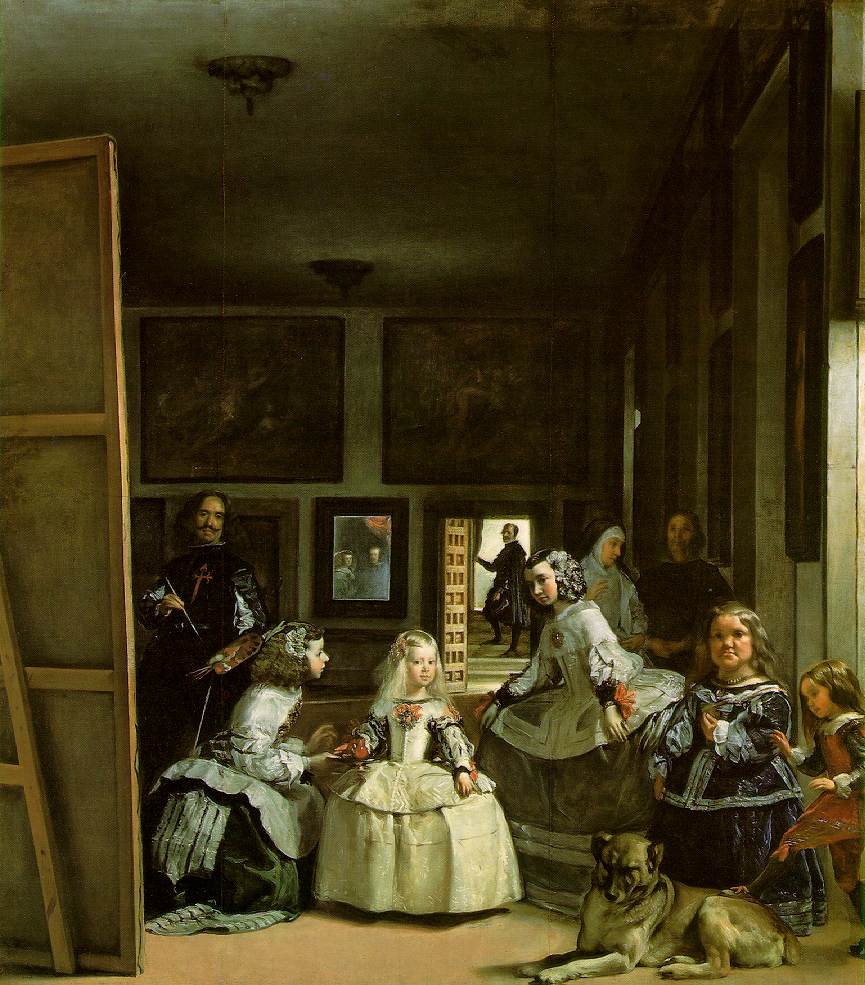
A painting I appreciated even more for different reasons was Las meninas, by Velazquez.  That may ring a bell: in my post about Barcelona, I mentioned that we saw Picasso's surrealist/cubist version of Las meninas.  At the time, I thought this was cool.  But then I saw the original:


Everything in this painting is spectacular.  First of all, it just looks pretty.  The girls in dresses, their ladies in waiting, etc.  Secondly, it's composed really well, with all of our attention diverting on the little girl first.  It's not even off-balance because the Duchess is in the center, despite the easel infiltrating the frame considerably when something else could go there in its place.  Then you start to notice every little Easter egg that Velazquez hides in it:

  • Everybody is looking at you.  The Duchess, one of her ladies in waiting, the old woman, the painter (Velazquez himself), even the chamberlain exiting in the back.  Why are they looking at you?
  • Because their watching you get painted.  And by you, I mean the king and queen.  Look in the mirror over Velazquez's left shoulder: that's their reflection.
  • So then you start to feel awkward because everyone is watching you get painted except it's not you being painted but instead someone with much higher status than you.  Then you suddenly feel out of place because not only are they looking at you, but they're glances change from passive to active, wishing you out of the picture so that Velazquez can finish.
  • It's a picture within a picture within a picture.  You realize this after you realize that the king and queen are being painted, and that the canvas on the easel will later become the one that is hanging proudly in the Prado that you are now looking at.  MIND TRIP.
Anyway, this is my new favorite painting.  Even Picasso's Guernica, which I stared at for just as much time in the Reina Sofía (also in Madrid), which moved me, did not make as much of an impression.  It certainly did make an impression, just a different one.  What I'm trying to say is, Las meninas is my new favorite.

After the Prado, we ended up going to the Hard Rock Cafe to eat.  I know this may seem like a dumb thing to do, but after not having American food for 3 months (Spaniard's attempts at making hamburgers do not count), it was nice to sink my teeth into something I've been missing.  And that was a burger.  My parents really wanted to go too, and I did not have the willpower or the want to insist otherwise.

Saturday saw us go to Toledo (look for that blog post later/tomorrow(?)), and then come back to go to the other really important art museum in Madrid, the aforementioned Reina Sofía, which was actually built to house Guernica, Picasso's incredibly political, anti-Franco mural-esque painting about the small village of Guernica in northern Spain.  Here's the story behind it:

During the Spanish Civil War, Franco was laying destruction to the majority of Spain as he went around conquering it.  At the time (I'm not sure about the situation today), Guernica was the capital of the Biscay province in Basque Country.  In order to help Franco win the war, some of the Nazi German air force and the Italian air force bombed Guernica, killing several civilians and effectively handing over power of the Basque Country to Franco.  (This is darkly ironic because Franco later did not participate in World War II -- he did provide the Axis Powers with under-the-table troops, but he wanted to keep his hands clean.  In short, he was an a**hole.)  Hearing about this, Picasso, who was living in France, was commissioned to paint a mural for the Paris International Exposition for the Worlds Fair in 1937.  After he finished it and it was displayed at this expo, it went touring, and eventually found a home in the MoMA in NYC, where it remained until 1981.  Franco had evidently expressed interest in having the painting transported back to Spain (which is also ironic, since he was largely the cause of its creation), but Picasso wouldn't allow it until Spain became a republic once more.  After Franco died and this came true, it was housed in an annex of the Prado, where it was placed behind bulletproof glass and guarded by machine guns.  Now, since the Reina Sofía has been built, it has a much less hostile home, although the museum employees will get angry with you if you take direct pictures.  (They disallow them out of respect for the art.)  If you want more information, check out the Wikipedia page here.  

My personal experience with Guernica was very powerful.  It is a huge painting -- literally, huge -- and its size contributes to its grandeur.  The faces on the painting are the most harrowing things in the work, really displaying how pained the citizens must have/could have been.  I wish I could describe more for you, but it's difficult.  Just take the time to examine it closely, even if you don't like Picasso.  It really is a fantastic piece of art.

After we left the Reina Sofía, we were lucky enough to have an opportunity to see a high-end flamenco espectáculo for nearly nothing, just a price of a bottle of wine.  This was thanks to Marisol, whose friend is the principal dancer in the company.  We enjoyed a nice bottle of wine, some free tapas, and a phenomenal show, containing two parts: a nice fusion of flamenco dancing with modern music, and then later more traditional music and dancing.  It was extraordinary!  Luis, Marisol's friend who got us our nearly-free table, was so nimble in the way he moved and yet so assured of where he was going that it partially convinced me that maybe flamenco wouldn't be hard (because he made it look so easy).  Of course, that's ridiculous.  We got to meet him afterwards, and he was so nice and was so glad that we were able to make it.  He made sure to tell me to give Marisol his greetings and lots of besitos (little kisses) for him.

The next morning, Mom and Dad had to go.  It was really hard seeing them go because I enjoyed my time with them so much.  They got to go off and do their own thing quite often, but we got to see each other a lot too.  I was so happy to share a bit of my experience in Spain with them (the food, the sights, the lifestyle, the main attractions, etc.) and talk with them about how things are going here and how things are going back home.  And even though I miss home more than ever now, it really made me feel grateful for this opportunity, even more so than I already did.  Because it is once in a lifetime.  And to have parents that understand that and wish me well and enjoy themselves when I show them how I've been living in my home away from home, that's a blessing.  So I just want to thank them again!  (And apologize that it's taken so long for me to write this post.)  You guys are the greatest.

After they left, though, Meagan and I still had quite a bit of time before our train back to Sevilla.  This mainly consisted of going to the market and getting some food, sitting in Plaza Mayor and eating most of it, and then walking down to Parque del Buen Retiro and sitting and enjoying more food.  The park had several attractions in it, namely some kind of stone pavilion alongside of a rectangular pool, a "Crystal Palace" made out of glass that is actually a satellite site of the Reina Sofía, and several street performers and artists.  One guy we saw made an exquisite finger painting (that didn't look like a finger painting at all, but more like a professional one) in 5 minutes flat.  They were pretty cheap, but there was a line and I had no idea where I would put it in my bag.  Here are some pictures of the park:


So that was Madrid!  We really only did 4 or 5 things in it because that's all that we felt there was to do.  But that's okay!  We enjoyed ourselves and that was important.  I definitely don't want to discourage anyone from going there, because you will enjoy yourself.  I promise.  My experience is not everyone's.  Go!  Spain is Spain.  I love all parts of it.

Nick

  • Digg
  • Del.icio.us
  • StumbleUpon
  • Reddit
  • Twitter
  • RSS

Cádiz

Last Tuesday, when my parents were here (!!!), we decided that we'd go to Cádiz, a city in the southern part of Andalucía famous for its huge celebration of Carnaval (the Mardi Gras of Spain), for the beaches in it and the surrounding area, and for its magnificent location.  Here's a picture of it from the air:


A picture much like this one will be adorning a wall in my room next year.  Seeing this spit of land from the air is amazing.  (Even better are the satellite images of the peninsula.)  In one of the places we went, there were actually drawn progressions of the development of the city, dating as far back as the first century, maybe even B.C.  I don't quite remember.

Which brings me to some interesting facts about Cádiz.  It is thought to be the oldest, continuously-inhabited city in the Iberian Peninsula, and possibly all of Europe, with a history that goes back all the way to the Phoenicians and later, the Roman Empire.  The Romans actually had quite a few strongholds in Spain, such as Cádiz and Itálica, which I blogged about back in January.  Cádiz functioned as one of the most important ports in Spain, functioning as starting points for some of Christopher Columbus' voyages, as well as a home base for the Spanish fleet.  It endured lots of hardship at the hands of others, namely raids, attacks, and occupation.  At one point, the English burned it down.  But it remained strong.

Because it's not very big, we were able to make a fairly decent day trip out of all the sights to see in the city.  And it was great!  We saw the famous cathedral, went up the Torre Tavira (which is still the tallest point in Cádiz and has been since the 17th or 18th century -- I'm not sure which), made it to one of the castles on the waterfront, touched the Atlantic, and got back to the train station in time for our trip back home to Sevilla.  The only downside to the whole trip was that it was (a lot) colder than we expected it would be, and it was not very nice weather.  That is to say, it wasn't very sunny.  So a lot of the pictures I'll post are dark and grainy.  But oh well.

My personal favorite part of the entire day was going up in La Torre Tavira and looking out over everything in the city.  Its oceanic isolation really makes you feel like you're on the cusp of the earth, with everything laid out like puzzle pieces on a glass table.  That may seem overly florid, but it's crazy when you can see it.  To be nerdy, it made me feel like I was stuck in The Legend of Zelda: The Wind Waker.  (If you don't know what that is, I don't blame you.  But that's what it made me feel like.)  My parents really enjoyed the tower too, as is evident by this photo:


Other things we enjoyed: THE FOOD.  In the torre, which has a camara obscura that shows you a real time picture of all the things going on in the city, there was a man that presented the show and talked in really, really good English.  So we asked him where we would recommend us going to eat.  Now, Marisol told me before I went that I needed to try some seafood there, because evidently, it's really good.  (Naturally, since Cádiz is practically in the ocean already.)  He recommended the Garbanzo negro, a nice little tapas bar right outside the tower.  So we went -- and found out he was right.  We had really good seafood croquettes, potatoes with a mojo picón sauce, some really good olives, et cetera, et cetera.  But the best part of the whole meal, at least for me: arroz negro con chocas.  (Or something like that.  I don't remember exactly.)  This translates to: "Black rice with diced squid."  I, for one, am a strong advocate for exotic food.  But what I found out this was turned out to be beyond even my imagination.  The rice is black in this dish because it has been tinted with squid ink.  (!!!)  And it was SO GOOD!  Oh my goodness.  If you ever see it anywhere, especially if you come to Spain, I recommend you try it.  I'm setting you up to be let down later, but seriously.  It was one of my favorite things so far.

I realize that the paragraph about food is the largest in this post, but I guess that's okay.  The city was pretty quiet while we were there, which was nice.  We could relax a little bit, take everything at our own pace, and just take it all in.  It's nice to be able to do that once in a while.

Overall, Cádiz to me seemed really eclectic.  Old, but new at the same time.  Rustic but loud and outspoken.  Traditional, yet ready to break free.  I could only imagine what Carnaval must've been like: tons of people gathered on this tiny spit of land at the edge of the continent, partying until the sun rose once again.  Kind of crazy to think about, right?  I'm surprised the peninsula didn't sink.

  • Digg
  • Del.icio.us
  • StumbleUpon
  • Reddit
  • Twitter
  • RSS

Frenchies

I hate publishing more than one post a day, but since I've been incredibly busy and preoccupied lately, and since I'm leaving to go on another trip tomorrow night, I might have to.  I've been meaning to do this specific post for awhile, but am just now getting around to it.  It'll be short, but hopefully interesting!

So.  Something I did not expect from my home-stay experience, other than a crazy host mother (in a good way, of course), is that the house would function as a sort of extended-stay hotel for other exchange students as well.  When Chris (my roommate) and I both got to Marisol's house for the first time, there was already another student living with her.  His name was Fran, and he was from Germany.  I'm not sure where in Germany, though.  Anyway, he was cool, though very reserved and often just in his room when he wasn't out hanging around Sevilla.  The coolest thing about Fran is that we could communicate in two different languages, because he knew quite a bit of English as well as Spanish and German.  (We also assumed that he could speak Russian since evidently he has a very serious relationship with a Russian girl -- and he has small businesses in Russia too.  Crazy.)

When he left, it was sad for us, but it was sadder for Marisol, since he had stayed with her longer.  But we didn't have to wait for very long until the next European students came to visit.  This time, they were too students traveling with a big group of others from their school in France.  (At one point, they told us where they were from, but I couldn't really understand what they said, nor could I write it down for you if I tried.)  When they arrived, Marisol asked me if I wanted to go pick them up with her.  Naturally, I said yes, because it was exciting.  However, we quickly figured out that Sylvain and Brice (sp.?), both 16, spoke almost no English nor Spanish.  I had to help them buy cigarettes at one point, which was a minor bump, but when I had to explain the rules of the house to them, I got the blankest looks I've ever been given.  It was scary, actually.  Never in my life have I been more grateful to be able to communicate in more than one language than when I had to try to communicate with them.  Unfortunately, French is beyond my comprehension.  Even the simplest of words/vowel and consonant sounds.

This past weekend, Marisol got too more students staying with her, who also happened to be traveling through Andalucía.  (I don't really know how she signs up for these things, but I guess she seeks them out or maybe gets recommended to others by our housing coordinator, Ángeles.  Oh well -- it's how she makes her living.)  They had been here since Friday or Saturday; I don't know because I was in Madrid.  (Another blog post for later!)  And Chris was gone too, in Lagos, Portugal.  So Marisol was left with two more French students for a whole weekend on their own.  We feared for her, given how communication went last time.  We also feared for the French kids, seeing as how Marisol was about ready to punch through a wall when she couldn't communicate with Sylvain and Brice.  Luckily for everyone, Alejandro and Pablo Emilio (as they introduced themselves to me), both 15, knew a lot more Spanish (and English) separately than either of the other two did put together.  They were really cool, but I still didn't get to hang out with them very much since they had plans to go on excursions to places like Córdoba and Granada when I didn't have class.  (And when I didn't have a paper to write or a test to study for.  For the same class to turn in/take on the same day.  UGH.)  Oh well.  Here's a picture of all of us together (which, by the way, took 10 minutes longer to take than it should have due to Marisol's perfectionist-like fussing):


Anyway, as for more boarders, Marisol mentioned something about Italians, but I'm skeptical that they're still coming, because Ángeles didn't say anything about it when I met with her on Tuesday.  Though she did mention that I will probably be getting my own room when the Summer Session Tar Heels come to stay in Sevilla.  (YES!  Yay, privacy!)  So I suppose that's something to look forward to.

I'll post later too!  I promise!

Nick

  • Digg
  • Del.icio.us
  • StumbleUpon
  • Reddit
  • Twitter
  • RSS

Matalascañas

I know I'm a little behind.  But I have an excuse!  My parents have been here for the past couple of days and I'm loving that they are here!  Of course, we're taking every opportunity to spend time together.  As such, blog posts would be hard to write.  So excuse me for this post about Meagan's and my beach trip last Saturday to a nice little town called Matalascañas.  (That literally means "Kill the sugarcanes."  We think.)

Getting there: we went to the farther bus station from where we both live to get tickets, and they ended up being pretty cheap!  I don't know how coach companies do it in the U.S., but in Spain at least, they usually leave you with a vuelta abierta, which means that you can choose to come back at whatever time you want, provided there are buses running then.  That option is also cheaper, so we went with that.  The bus ride wasn't too long, maybe about an hour and a half each way.  The drive wasn't the prettiest either, but we did get to drive through Spain's main national park, of which they are very proud.  It's called Doñana National Park, and from the looks of it, it seems pretty cool!  We only saw a very small portion, and it probably wasn't the best portion to see (mainly because it was the roadside part of the park, which is never as pretty as the more secluded areas).  But it was still cool!  Evidently, Doñana is where they grow most, if not all, of their strawberries.

To go back a little bit, before setting off the night before, I asked Marisol's (my señora's) friend Antonio for advice on where to go and what beach to visit.  45 minutes later, I had learned that the two best parts of the beach are (1) by la piedra, which is the ruin of an older lighthouse that crumbled to the ground after the beach eroded back to where it is today.  Advantage: cool landmark!  Disadvantage: lots of people and short beach.  The other part he described to me was (2) near a part of the town called El pueblo andaluz, in which I discovered that Marisol used to have a piso (apartment)!  (I later told her I knew that and she kind of blushed.  I don't really know the story behind this, but I think she shared it with her brother.  I don't know why that fell apart, though.)  Advantage of this beach: very long beach and not as many people.  Disadvantage: no guarantee that the bus would go there to drop us off or pick us up.  (Obviously, that was a pretty big disadvantage.)

When we got to Matalascañas, we figured it would be easier to just go to the short beach, even though there were a lot of people.  That didn't stop us from having a great day!  We really wished that the ocean had been warmer, though.  We only got to put our feet in before running back to the sunny sand to warm them up again.  (It was really cold.)  Other (cool?) experiences: got to see la piedra, which translates directly to "the stone," but didn't get to touch it (because the ocean was so cold); had our first/second nudist experience when a woman decided to remove her top; saw my first open chiringuito, which is a dive-ish beach bar; and found out that Spain has public bathrooms on the beach that only cost 20 cents, but I'll be damned if there were any open ones.  I guess it was the off-season.

Here are some pictures for your enjoyment!


Overall, the trip was fantastic!  I foresee many beach trips in the future, maybe when the water gets warmer.

  • Digg
  • Del.icio.us
  • StumbleUpon
  • Reddit
  • Twitter
  • RSS

Paris

ATTENTION: If you are between the ages of 18 and 25, get yourself a visa and get yourself to Europe.  For citizens (permanent or temporary, which includes visas) of the European Union, there is a such thing as a Young Person's Discount, which applies if you are between those ages previously mentioned.  (Unfortunately, it's only for the EU instead of all 18- to 25-year-olds.)  I know this is easier said than done, but really, you need to capitalize on this opportunity if you can.  For example, this weekend in Paris (yes, Paris), Meagan and I both got into the Louvre and the Musée d'Orsay for free.  That's right, THE LOUVRE FOR FREE.  We simply had to flash our visas and they were more than happy to give us tickets.

But if you can't do that, you should still visit Paris, if you're over here.  Visiting the city is almost a prerequisite if you're coming to Europe.  And I will tell you right now: it is worth it.  And even though it's the most expensive city in the European Union, perhaps in the world (although I find that hard to believe after having visited NYC twice and having been financially gutted both times), you can still survive it by hardly spending anything.  (The discount mentioned above certainly helped.)

And while I'm sure it would be wonderful for me to describe the entire weekend to you, I'm not going to do that.  I know I sort of did it with Barcelona, but we weren't really there for a whole weekend.  We weren't even there for a whole two days, really.  And that post was long.  So!  I'm going to rein in my unwanted talent for superfluous description and stick to the highlights of the weekend, good or bad.

Starting with: the airport bus.  Sevilla has a really proficient bus system.  They go everywhere over the city and they're usually pretty reliable...unless, evidently, you're trying to get to the airport on a Friday night.  The airport bus is really quick and efficient, and it only costs 2,40 euro, which is much cheaper than taking a taxi.  However, taking a taxi is exactly what Meagan and I had to do after the bus never showed up after waiting for the better part of an hour.  Granted, we got to the stop pretty early, but there's still a big difference between 2 1/2 hours before take-off and 1 1/2 hours before take off.  The ironic part is this, though: once we finally flagged down a taxi, got in, and got situated, we look out the rear windshield, and a bus that looks awfully like the airport bus pulls up to the stop.  We kind of hated ourselves for that decision, since we had to pay 22 euro instead of 2,40.

But all's well that ends well.  We got to the airport with plenty of time, got through the (strangely) busy security line, and got on our plane to take off.  Everything on the flight was in French and heavily-accented and hard-to-understand English, but that didn't matter, because we were going to Paris!  (Though, it was hard to tune out the entire field trip of French elementary schoolers that continued to run up and down the aisle playing with their friends.)

The next morning we got up bright and early to go to the Louvre, where, given the hour, hopefully there would be fewer people.  Turns out we were right!  We were able to get inside the museum fairly quickly (and, let me say again, FOR FREE) and get to exploring.  Of course, the museum is famous for being the king of all museums, but let me reiterate: this place is HUGE.  It is chock-full of so much art and history that you wouldn't be able to find in very many other places.  Examples of things inside the Louvre: a section of an ancient Egyptian tomb, a section of an ancient castle's moat, the Code of Hammurabi, and of course, paintings like the Mona Lisa and the Wedding at Cana (which is huge, by the way).  And the Louvre lets you take pictures!  Here are some examples:


At that point, we were pretty hungry and grumpy from not having eaten yet.  So we sought out a cafe that wasn't too expensive and found success!  Breakfast in French is petit déjeuner, and we got to have half of a traditional one: toast with jam and butter, served with coffee or hot chocolate.  While it was good, it was one of the last times we wanted to spend money at a cafe, so we went grocery shopping!  And by grocery shopping, I mean bread shopping.  If you go to Paris, I highly recommend buying two or three baguettes (depending on who's with you) and just munching on them all day.  Couple that with some strawberries, some cheese, and maybe some juice or wine, and you're set for at least two meals if you can stand having the same thing for both meals.  Meagan and I did this and we were set for the day.

So we proceeded onward with our exploration of the city!  One of my favorite parts was visiting Le jardin des Tuileries.  And my real reason for doing this was because a part of Mussorgsky's symphonic work, Pictures at an Exhibition -- which is divided into movements based on paintings he saw at...an exhibition, of course -- is based on these gardens.  (You can listen to it by watching this video; the Tuileries movement lasts from 0:29-1:37.)  And the gardens certainly weren't a letdown!  It was very grassy and beautiful, with statues and ponds and rows of trees everywhere!  We had a lot of fun watching everyone run around.  Also a plus: evidently, we went on a day where it wasn't very crowded.  So props to us!


Later, we braved the metro once more (we had bought the Paris Visite pass, which allows for unlimited rides on any public transportation system for 2 days), all the way from the Arc de Triomphe to the Cathedral of Notre Dame.  Which is situated on an island in the middle of the Seine, by the way.  I didn't know that until I was on the island.  Of course, many memories of Disney movies came flooding back to me as I saw the belfries and attempted to take good pictures of the gargoyles on the top of the cathedral.  (Pictures below.)  Meagan and I didn't go inside because the line was horrendously long, but that was fine by us.


Up until this point, we'd had really good weather, considering Paris has a reputation for being rainy.  But on our way to the Eiffel Tower, evidently the clouds opened up and rain started to pour.  So we had to change our plans a little bit, find somewhere to eat our groceries inside, and then go back later.  Well, that turned out to be a good choice!  Of course we were always going to go see the Eiffel Tower at night, but this just made it so that we saw it at night first before we saw it in the daytime.  And it was beautiful!  It was kind of difficult to take pictures, but we managed.

Later, we walked under the tower, where the finish line for some kind of race was, and saw it from underneath.  The views you get from underneath are crazy!  Also, the Eiffel Tower is always packed with people, either tourists, street vendors, or maybe the seldom Parisian.  Know this, though -- there are street vendors EVERYWHERE!  And all they sell are robotic pets, Eiffel tower trinkets (like statuettes and key-chains), and plastic glow-in-the-dark paratrooper type things.  There was one guy, though -- and this merits a story -- that was selling roses.  As you would expect, Meagan and I were approached by this man, who promptly told us that one rose was 3 euro.  I told him that it was too much, and so he asked me how much I was willing to pay, so I said along the lines of 1 to 1,50.  And while his price didn't go down that much (2 roses for 5 euro), it was perfect.  One rose for each of us!  So we got to hold our roses while the Eiffel tower sparkled above us.  It was wonderful!  :-)


But enough gushy details.  Later, we went back up to Montmartre where we were staying, and passed by the Moulin Rouge.  Which is funny, because the Moulin Rouge is in the middle of the Red Light District of Paris, and there are tons of tourists there trying to take pictures.  (Also, funny: because we didn't realize that the Moulin Rouge was a block away from where we were staying, we also didn't realize until we got there that we were staying a block away from the Red Light District as well.  Things you learn by wandering.)  My recommendation for you in regards to the Moulin Rouge is to see it, but then go to the crepe place on the corner of the street directly to the right of it (if you're facing it).  So good and so cheap: a Nutella crepe was only 2 EURO.  I REPEAT, 2 EURO.  This is cheaper than we found in any other part of the central part of Paris.  It was a deal.

The last thing I'll mention before I leave you wanting more details is in regards to the Musée d'Orsay, the other main art museum in Paris.  While the Louvre was cool (and humongous) and had amazing things in it, the Orsay was more interesting, in my opinion.  We honestly found that the Louvre's size was a hindrance, simply because it's impossible to see all of it at once unless you're really dedicated.  It's hard to appreciate that much art and history in such a large quantity.  The Orsay was better: it wasn't as big and it had a lot more modern-day art, such as Impressionism.  For example, Monet's Water Lilies is usually here (we didn't see it, because we think it was on loan), as well as Edgar Degas' ballerina collection.  All of it is amazing, and the museum itself is quite cool too.  There's a gigantic clock hanging above the main entrance (also the exit), but you don't see it until you turn around to face the exit.  Unfortunately, they wouldn't let us take pictures in the Orsay.  When we were about to leave, I wanted to buy art postcards, but they were pricey for postcards and we didn't exactly have a budget that allowed for excess spending.  ("Excess spending?!" you say.  "You were in Paris!"  Yes, but I was in Paris with a strict budget.  We still had to buy food for Sunday.)  Anyway, if I had bought postcards, I would've gotten one by Cézanne, who I am quickly coming to realize is my favorite Impressionist painter; and I also would've gotten this one (below), which is probably my favorite painting in the museum, for no reason that I am aware of except that I like it.  It's called The Snake Charmer, by Henri Rousseau:


Other adventures included walking down the Champs-Élyssés, standing under the Arc de Triomphe, and sitting outside the Palais du Luxembourg on our way back down to the bus that would take us back to the airport.  It really was a fantastic weekend.  Hope you enjoyed the pictures!


Nick

  • Digg
  • Del.icio.us
  • StumbleUpon
  • Reddit
  • Twitter
  • RSS